Task Management Module Design
TrailSnap is an AI photo album deployed on NAS devices. This architecture is designed with NAS characteristics in mind (typically low CPU performance, no GPU acceleration, large photo collections stored on HDDs, while Docker and other software are installed on SSDs).
1. Overall Architecture
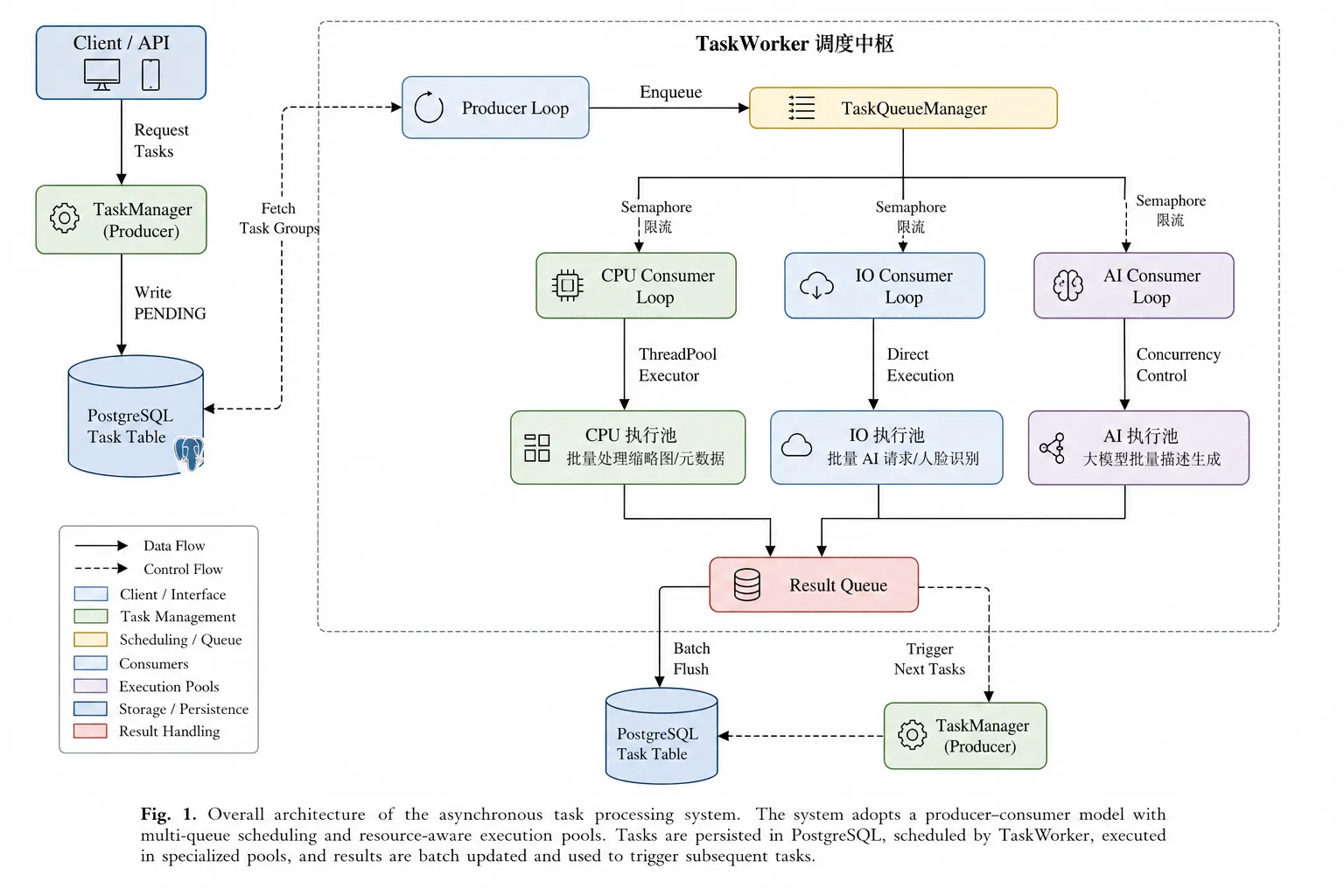
The task management module adopts a Multi-Level Buffer + Producer-Consumer model, using PostgreSQL as the persistent backend and in-memory priority queues as the scheduling hub, achieving complete decoupling between task production and consumption. The architecture consists of four core components:
- Producer (TaskManager): Runs in the API service process, responsible for receiving user requests or system-triggered events, generating tasks and writing them to the database.
- Persistent Task Queue (Database Table): The
Tasktable serves as reliable persistent storage, storing task type, status, priority, payload parameters, etc., ensuring tasks survive service restarts. - Scheduling Hub (TaskQueueManager): An in-memory scheduling module in
task_worker.pythat maintains three independent priority queues (CPU / IO / AI), responsible for batch-fetching tasks from the database and priority-sorting them. - Consumers (TaskWorker): Three independent worker coroutines (CPU Consumer, IO Consumer, AI Consumer), each listening to its categorized queue, consuming tasks at adaptive rates and processing them through execution pools.
Architecture Diagram
2. Core Design Principles
2.1 Strategy + Factory Pattern
The task execution layer uses the Strategy Pattern for complete decoupling:
- BaseTaskStrategy (abstract base class): Defines the interface all task handlers must implement, including
process()(single task),process_batch()(batch processing), andhandle_completion()(completion callback). - TaskStrategyFactory (strategy factory): Uses class method registration (
@TaskStrategyFactory.register(TaskType.XXX)) to maintain a mapping fromTaskTypeto concrete strategy classes. The scheduling layer has no dependency on specific task types — it only obtains strategy instances dynamically through the factory, achieving the Open-Closed Principle (OCP): adding new task types requires no changes to the scheduling core.
2.2 Feedback-Driven Adaptive Production
A common problem with traditional polling models is wasteful database I/O: data is fetched at a fixed frequency regardless of queue backlog.
This system implements queue-depth feedback-driven production logic:
TaskQueueManagerexposes theqsize()of all three queues in real time.- The producer checks whether each queue length is below a threshold (
QUEUE_THRESHOLD = 50) before every loop. - Tasks are only fetched from the database when a queue is idle and below the threshold. Fast consumption triggers fast replenishment; slow consumption halts production — a truly "consumption-driven production" energy-efficient model.
2.3 Multi-Level Batching
To maximize processing efficiency and reduce database I/O frequency, the system implements a three-level buffer architecture:
- Database: As persistent storage, each query fetches up to 150 PENDING tasks.
- In-memory task queues: These 150 tasks are grouped by
TaskType, then sub-grouped into batches of 8. Each group is an "raw batch" placed into the corresponding categorized queue. - Execution pools: When an execution pool receives a raw batch, it obtains the corresponding strategy instance from the factory and calls
process_batch()for batch processing, reducing CPU scheduling overhead.
This design ensures low-frequency database I/O (fetching a large batch at once), lightweight in-memory task objects, and maximum utilization of the AI microservice batch API (8 images per batch is the optimal throughput point).
2.4 Priority Queue Scheduling
TaskQueueManager uses asyncio.PriorityQueue for each categorized queue:
# Enqueue element structure: (negative priority, counter, batch list)
await queue.put((-priority, count, batch))- Priority negation: Python's min-heap pops the smallest value first, so negation makes higher priority values get consumed first.
- Counter tiebreaker: When two batches have the same priority, a monotonically increasing counter differentiates them, avoiding
TypeErrorfrom comparing dictionaries.
3. Producer & Consumer Coordination
TaskManager serves as the task entry point, containing five coroutines:
task Worker (producer coroutine): Monitors task queue status, fetches tasks from the database based on thresholds, and pushes them into the corresponding queues.
CPU Consumer (consumer coroutine): Takes batches from the CPU queue, processes thumbnails/metadata in bulk.
IO Consumer (consumer coroutine): Takes batches from the IO queue, processes AI requests/face recognition in bulk.
AI Consumer (consumer coroutine): Takes batches from the AI queue, processes LLM description generation in bulk.
Result Handler (result coroutine): Gets processing results from
result_queue, batch-updates database status.
Producer & Scheduling Hub
- Responsibilities: Batch-fetch PENDING tasks from the database, group by TaskType, split into standard batches (≤ 8 per batch), assign the priority of the first element as the batch priority, and push into the corresponding in-memory categorized queue.
Consumer Concurrency Control
Each consumer coroutine maintains an asyncio.Semaphore for fine-grained concurrency control:
| Queue Type | Max Concurrency | Use Case |
|---|---|---|
| CPU | os.cpu_count() or 4 | Thumbnail generation, metadata extraction |
| IO | 10 | Face recognition, OCR, image classification, vector embedding |
| AI | 2 | Visual description generation (depends on LLM, scarce resource) |
A consumer must acquire a semaphore permit before taking a batch from the queue — this ensures that even if the database fetches a large number of tasks at once, memory won't be exhausted by unlimited concurrency.
Async Result Processing
After each task completes, the database status is not updated immediately. Instead, results are written to result_queue and batch-processed by the Result Handler coroutine.
4. Task Strategy System
All concrete task handlers inherit from BaseTaskStrategy and register via @TaskStrategyFactory.register(TaskType.XXX).
4.1 Strategy Base Class Interface
class BaseTaskStrategy(ABC):
    @property
    @abstractmethod
    def task_category(self) -> str:  # Returns 'CPU' | 'IO' | 'AI'
        pass

    @abstractmethod
    async def process(self, worker, task: Task, db: Session) -> Any:
        pass  # Single task processing (legacy interface)

    async def process_batch(self, worker, tasks: List[Task], db: Session) -> List[Dict]:
        # Default: calls process() in a loop; subclasses can override for true batch processing
        results = []
        for task in tasks:
            res = await self.process(worker, task, db)
            results.append({...})
        return results

    async def handle_completion(self, worker, items: List[Dict], db: Session) -> None:
        # Post-completion callback for triggering follow-up task chains
        # (e.g. PROCESS_BASIC completion triggers metadata extraction)
pass4.2 Typical Strategy Implementations
BasicTaskStrategy (CPU Batch Processing)
CPU tasks (e.g. thumbnail generation) involve heavy synchronous blocking I/O (file reads/writes) and CPU computation (OpenCV).
Optimization: Implements process_basic_cpu_batch_job, which processes 8 sub-tasks sequentially within a single thread pool call:
def process_basic_cpu_batch_job(tasks_data: List[Dict]) -> List[Dict]:
    results = []
    for data in tasks_data:
        res = process_basic_cpu_job(data['file_path'], data['file_id'], ...)
        results.append(res)
return resultsThis way, thumbnail generation for 8 images shares a single thread pool context switch overhead, significantly improving CPU-intensive task throughput.
AI/IO Strategy (Network Batch Requests)
For tasks that depend on the external AI microservice (e.g. face.py, ocr.py), process_batch combines Base64 encodings of 8 images into a single HTTP request:
async def process_batch(self, worker, tasks, db):
    b64_images = [read_image_base64(p) for p in valid_photos]
    async with aiohttp.ClientSession() as session:
        async with session.post(api_url, json={"images": b64_images}) as resp:
            results = (await resp.json())['results']
# Batch-parse results, batch-update databaseThis reduces 8 network round-trips to 1, significantly mitigating the impact of network latency on overall throughput.
5. Task Priority
Task priority is implemented via the priority field (integer) in the Task table, where larger values indicate higher priority.
- Default priorities: The system defines a
DEFAULT_PRIORITIESdictionary to automatically assign priorities to different task types.SCAN_FOLDER(100),PROCESS_BASIC(99),GENERATE_THUMBNAIL(98),EXTRACT_METADATA(97): Scanning and basic media processing.- AI tasks:
CLASSIFY_IMAGE(10),RECOGNIZE_FACE(9),IMAGE_EMBEDDING(8),OCR(7),RECOGNIZE_TICKET(4),VISUAL_DESCRIPTION(1). - User-initiated interactive tasks use priority 10000 and can run while automatic work of that type is paused.
- Scheduling logic: When consumers take tasks from in-memory queues,
PriorityQueueautomatically ensures higher-priority batches are consumed first. - AI phase switching: Tasks of the same type run consecutively to reduce model switching. When a runnable higher-priority type arrives, the producer stops replenishing the current type and withdraws queued batches. It switches after in-flight batches and result persistence finish. Remaining tasks stay PENDING and resume later; equal or lower priorities do not interrupt a phase. Paused tasks, extension maintenance and future retry deadlines do not trigger a switch.
6. Task Status Management
Tasks transition between the following states during their lifecycle (defined in the TaskStatus enum):
- PENDING: Initial state — task created but not yet executed.
- PROCESSING: Executing — Worker sets this status immediately after fetching the task.
- COMPLETED: Execution successful — usually the record is deleted from the database to keep the table lightweight.
- FAILED: Execution failed — record retained in the database with error info for troubleshooting.
Startup Recovery Mechanism:
On service startup, TaskWorker runs _recover_unfinished_tasks, resetting all tasks in PROCESSING status to PENDING, ensuring tasks are not lost after an unexpected crash.
7. Exception Handling & Timeout Control
Timeout Mechanism
Each batch execution is wrapped in asyncio.wait_for:
- AI tasks (dependent on LLM response): 120 seconds timeout.
- CPU / IO tasks: 300 seconds timeout.
On timeout, all sub-tasks in the batch are marked as FAILED with a timeout error message, preventing a single slow task from permanently consuming a concurrency slot and paralyzing the system.
Exception Handling
- Batch-level capture: Unified interception in
execute_batch_task_wrapper, written toresult_queue. - Strategy-level fault tolerance: Each strategy's
process_batchhandles business exceptions internally (e.g. file not found, resolution filtering), returning structured failure results. - Process-level fault tolerance: The Worker main loop contains broad
try-exceptblocks with gracefulasyncio.CancelledErrorhandling, ensuring severe errors from a single task or strategy do not crash the entire Worker. - System-level fault tolerance: Even if the system crashes entirely (power loss, restart, etc.), uncompleted tasks are persisted in the database. On restart, tasks are automatically recovered and re-executed. Some tasks may have already completed but their database status was not updated — re-executing them is safe because all task operations are idempotent.
8. Resource Management & Lifecycle
Dynamic Execution Pool Management
- ProcessPoolExecutor: For CPU-intensive tasks — high cold-start cost, shuts down after 300 seconds of idle time.
- ThreadPoolExecutor: For IO-intensive tasks and CPU task batch wrappers — shuts down after 300 seconds of idle time.
- AI consumer concurrency limit: Strictly controlled via
asyncio.Semaphore(2)to prevent overwhelming the external AI service.
Exponential Backoff on Idle
When all queues are completely idle, the Producer loop uses exponential backoff sleep:
backoff_delay = min(1.0 * (1.5 ** retries), 10.0) # 1s → 1.5s → 2.25s → ... → 10s capAfter 5 minutes of continuous idle, the Worker exits automatically to release all resources. It will be restarted by the external monitor when new tasks arrive.
9. Performance Optimization Summary
| Technique | Description | Effect |
|---|---|---|
| Multi-level buffer architecture | Database → memory queue → execution pool | Read-write separation; 90%+ reduction in DB I/O |
| Adaptive production rate | Queue-depth feedback-driven fetching | Eliminates empty polling; CPU usage near zero when idle |
| PriorityQueue scheduling | Higher-priority tasks consumed first | Zero-delay response for critical tasks |
| Batch packaging (8/batch) | AI microservice batch API | Network round-trips reduced to 1/8 |
| CPU batch thread processing | Sequential processing of 8 images in one thread | Thread switch overhead reduced by 87.5% |
| asyncio.Semaphore throttling | Coroutine-level concurrency control per consumer | No risk of unlimited in-memory concurrency |
| asyncio.wait_for timeout | Batch execution timeout safeguard | Single slow task cannot paralyze the system |
| Exponential backoff + auto-exit | Energy-saving during idle | All resources released after 5 min of inactivity |
| Delete on completion | Successful tasks removed from database | Task table stays lightweight; queries never degrade |
10. Extension Guide
Adding a New Task Type
- Add the new type to the
TaskTypeenum inapp/db/models/task.py. - Create a new strategy class inheriting
BaseTaskStrategy, implementingprocess()orprocess_batch(). - Register using
@TaskStrategyFactory.register(TaskType.NEW_TYPE). - Add a default priority in
task_manager.py'sDEFAULT_PRIORITIES.
No changes to the TaskWorker core code are needed to integrate a new task type.